
project
Capital One® Virtual Teller
user experience design
role:
user experience design,
user experience research
deliverables:
usage research data elicitation and analysis
data modeling
prototyping
design
Banks were one of the essential establishments that did not closed completely during the height of the COVID-19 pandemic. Though adjustments were made to create safer banking options, problems around the limited one-to-one interaction and lack of understanding of online banking revealed issues and insights that fueled the ideas for the creation of the Capital One® Virtual Teller.
Problem
Capital One® customers who are unfamiliar with online banking are frustrated and sometimes unable to complete regular in-person banking transactions due to long waits and limited bank staff. Universal bankers are constantly diffusing customer frustration and taking on additional work because of the current limited staff capacity.
Goal
Improve the interaction between the customer and universal banker's through a safe, informative and inclusive end-to-end experience
Solution
Identify key pain points from both customer and universal bankers to devise inclusive change to Capital One®'s current practices that serve beneficial to both parties.
Major roles
Branch Ambassadors:
The bank employee responsible for handling various customer financial transactions
(deposits, withdrawals, transfers, checking, ATM maintenance and customer service)
Managers:
The bank employee who oversees Branch Ambassadors, business and
high-level banking and other branch-related daily operational tasks and duties
Customers:
The bank’s end-users
Machine roles
Online banking:
Use of website and app for banking needs
ATM:
In-house machine for personal banking needs
Work Artifacts & Task Data




Flow Model
This flow model displays the various courses of interactions that a bank customer can have – whether that is to complete a transaction via ATM or by way of human interaction, or receive one-on-one assistance by desk service.
The Capital One Branch Ambassadors I interviewed
expressed that the bank is trying to prepare to go fully digital so ideally, they would prefer little to no human interaction. However, there are current barriers that prevent that – for instance if the ATM malfunctions or is not able to give small change, it forces the customer to interact with either a Branch Ambassador or Manager in order to complete or be content with the their transaction. There is also the more recent barrier depicted here due to COVID safety protocols. When a customer is refusing to wear a mask within the bank, there may become disruptive or even disrespectful and would have to answer to a Manager to deescalate the situate.

Artifact Model for
ATM Usage
This artifact model specifically takes a deeper look at the customer’s interaction with the ATM. The tangible elements included are the debit card, the ATM and the cash vault.
During the pandemic, ATM usage increased as there were a lower number of workers available in the bank. This created a wait time barrier as ATM lines were longer than usual. Also, with more people using the ATM, it yielded malfunctions as well as in increate in the amount of time a Branch Ambassador would need to fill the ATM by going to the cash vault.
Additionally, there has always the debit card barrier where customers without a card are not able to access the ATM. So those who do not have a card or just prefer human interact would instead be in contact with a Branch Ambassador to complete their transaction.

Physical Work Environment Model
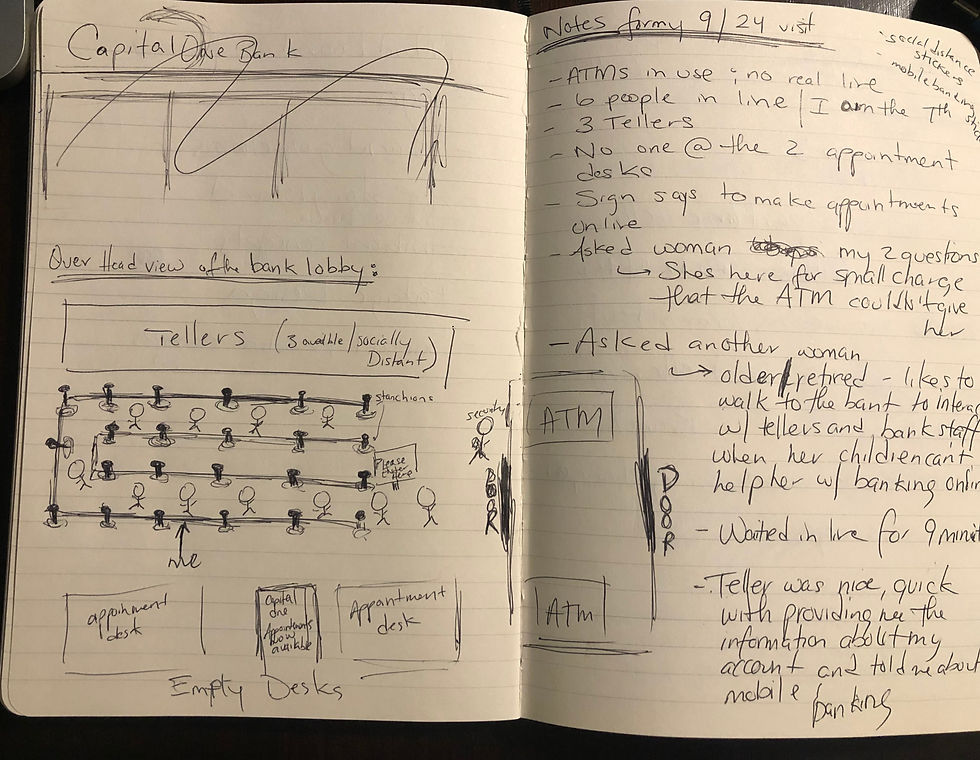
I was able to use my sketch of my bank’s layout the essence of this Physical Work Environment Model. One of the most notable barriers was the fact there were empty appointment desks. At the Capital One branch that I visited, there was an information sign there stating that if a customer wanted an appointment, they would have to schedule one online. There were people who came is who just wanted to speak to someone (whether that be to review an business account or set up a savings) and that were advised to schedule an appointment online.
There was a Branch Ambassador with an iPad that was able to help those who are less computer savvy to make the appointment, but it can feel like an inconvenience for the customer to come to the bank and not be serviced right there and then. The other barrier is the long wait in line. Granted I went to the bank during a peak time, so the line was extremely long.

User Work Role Model

Hierarchical Task Analysis
This HTA displays the ultimate task of depositing a check which directly corresponds with the bank customer work role. This task is something that can be done in many ways by means of online banking, the use of an ATM or by visiting in-person a teller/branch ambassador. There are multiple tasks to consider for either of the options, so I thought that it would be fitting to structure and analyze.

User Persona

Mind Mapping

Conceptual Design


Storyboard

Wireframe
